
Industrial chocolate raw material supplier Indonesia provides the foundational cocoa commodities to meet the production scales of global food, beverage, and cosmetic factories. The transition of the cocoa processing sector in Indonesia facilitates the availability of semi finished and advanced processed products with measurable technical specifications. Large scale F&B manufacturing facilities require consistent parameters regarding fat percentages, pH levels, and particle sizes to ensure formulation stability on their automated production lines.
Below are the details regarding the specifications of various industrial chocolate raw material lines manufactured in Indonesia.
Products from an Industrial Chocolate Raw Material Supplier Indonesia

The capacity of a processing plant is evaluated by its ability to break down raw cocoa beans into a broad spectrum of derivative products. Based on the Halal Product Assurance Organizing Agency (BPJPH) registration data under certificate number ID36110035201211125, issued on November 29, 2025, PT Jaya International Group manufactures the following raw materials for B2B requirements:
- NATURAL COCOA POWDER
- STANDARD BLACK COCOA FAT 8-10%
- PREMIUM BLACK COCOA FAT 10-12%
- COCOA POWDER PREMIUM CHOCOLATE
- PREMIUM ALKALIZED FAT 20-24%
- COCOA BUTTER
- COCOA CAKE
- COCOA NIBS
- COMPOUND DARK
Each product entity listed above undergoes distinct thermal and mechanical processing routes designed for specific industrial applications.
Specifications of Cocoa Powder Variants
Best cocoa powder represents the raw material with the highest volume demand. Variant selection is based on the target color, flavor profile, and solubility level of the final product.
1. Natural Cocoa Powder
This variant is extracted from the cocoa cake without the addition of neutralizing agents. The powder retains the natural pH level of the cocoa bean, ranging from 5.2 to 5.8. Its physical characteristics include a light brown color with an inherent acidic and fruity flavor profile. In industrial applications, natural powder is utilized extensively in bakery facilities for dough formulations utilizing sodium bicarbonate (baking soda), where the powder’s acidity reacts to generate carbon dioxide gas for dough expansion.
2. Black Cocoa Powder Category (Standard 8-10% & Premium 10-12%)
Black cocoa powder is processed through an extreme alkalization level (often referred to as the ultra Dutched process) that pushes the pH level to 8.0 or higher. This process darkens the powder’s pigment to a deep black color.
- Standard Black Cocoa Fat 8-10%: Contains a low fat percentage, optimized for dark biscuit manufacturing (such as black sandwich biscuits) that require a deep color with a dry texture, reducing production costs in mass applications.
- Premium Black Cocoa Fat 10-12%: Contains the standard fat ratio recognized by Codex Alimentarius. The extra fat provides a more solid chocolate flavor intensity compared to the 8-10% variant, applied in premium dark pastries.
3. Premium Alkalized Fat 20-24%
This variant is classified as high fat cocoa powder. With a cocoa butter retention of 22% to 24%, this powder offers a heavier physical texture and a much thicker mouthfeel. This product is not designed for instant solubility in cold water; rather, it is applied specifically in the ice cream industry, truffle manufacturing, and premium hot dairy beverages where additional cocoa butter is required to bind product emulsions.
4. Cocoa Powder Premium Chocolate
This is a specific powder formulation where the roasting profile is calibrated to replicate the aroma of solid chocolate bars. The temperature curve adjustment during roasting ensures the Maillard reaction reaches an optimal point, providing instant beverage manufacturers with a raw material that delivers a dense chocolate aroma without the need to add liquid cocoa mass to their formulations.
Solid and Fat Derivatives
Beyond powder products, F&B manufacturing requires the base structural components of chocolate for molding and enrobing processes.
Cocoa Nibs
Nibs are the pure core of the cocoa bean that has undergone roasting, breaking, and separation from its outer shell (winnowing). This material is the primary base for manufacturing cocoa mass (cocoa liquor). Outside of further processing functions, cocoa nibs are also marketed directly as inclusion raw materials (providing a crunchy texture) for the cereal bar industry, granola manufacturing, and high protein dietary food products.
Cocoa Cake
Cocoa cake is the solid, hard disc residue remaining after cocoa mass is pressed using high capacity hydraulic machines to extract its fat. This product is a transitional phase before the material is milled (micronization) into powder. Certain multinational factory facilities purchase the raw material in whole cocoa cake form to grind internally using the specific mesh specifications of their own machinery.
Cocoa Butter
Cocoa butter is the pure fat extracted from cocoa mass, presenting as a pale yellow solid at room temperature. Its primary technical characteristic is fat crystal polymorphism, which provides a specific melting point ranging from 34°C to 38°C (near human body temperature). This melting profile makes it an irreplaceable component in premium couverture chocolate production and in the cosmetic industry as a base for moisturizing lotions and lipsticks.
Advanced Processed Products: Compound Dark
Processing facilities in Indonesia also supply ready to use chocolate raw materials for the food service and HORECA sectors in the form of Compound Dark.
Unlike couverture chocolate, which relies entirely on pure cocoa butter, compound chocolate is manufactured by substituting a specific percentage of the cocoa butter with Cocoa Butter Substitutes (CBS) based on vegetable fats (such as fractionated palm oil).
This food engineering approach produces a Compound Dark that possesses a significantly higher melting resistance in tropical climates, requires no temperature tempering prior to use, and exhibits a rapid freezing point when applied as a coating for biscuits, ice cream, or donuts.
Regulatory Compliance and Food Safety Infrastructure
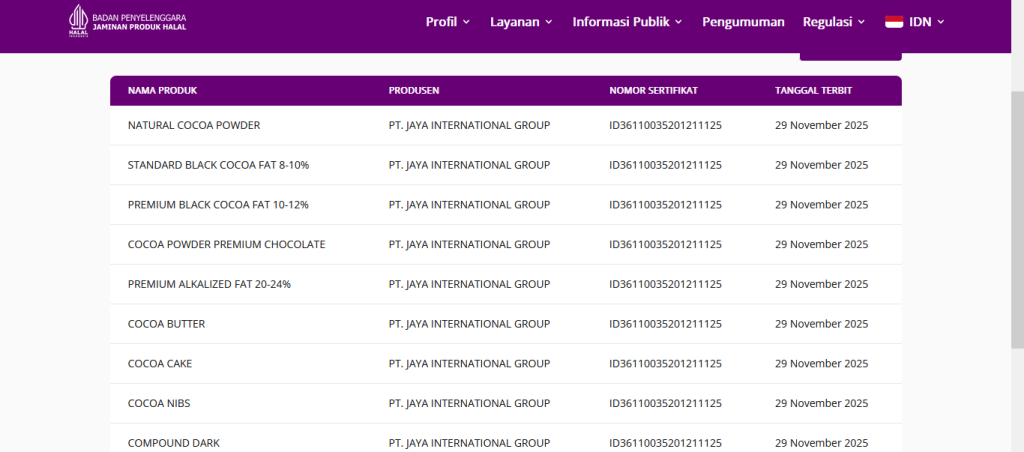
Facilities manufacturing the variants above operate under global export compliance parameters. The certification document numbered ID36110035201211125 issued by BPJPH is direct evidence of a strict Halal Assurance System (SJH) implementation.
This compliance mandates that all production inputs, including alkalizing agents like potassium carbonate, filtration water, and synthetic lubricants on hydraulic machines, are free from non halal contamination. The plant applies Sanitation Standard Operating Procedures (SSOP) across all mixing tanks and milling lines to prevent cross contamination between product batches, ensuring consumption safety on a global distribution scale.
International manufacturing procurement divisions can access these industrial raw material specifications directly from the source. All product specifications, from black cocoa powder variants for biscuits to compound dark for confectionery coatings, are packaged in standard multi ply kraft paper sacks with polyethylene liners to maintain moisture stability below the 5.0% limit during maritime logistics expeditions. To request Technical Data Sheets (TDS), copies of BPJPH certificates, or to arrange sample shipments for independent laboratory analysis, contact the export division of PT Jaya International Group:
- Corporate Address: The Zora Commercial Business Living, Ruko Daikanyama Block A 07, Jl. Lingkar Botanika Utara, Lengkong Kulon, Pagedangan, Tangerang, Banten 15339, Indonesia.
- Direct Contact: +62 851 7851 7789
- Email Correspondence: info@jayainternationalgroup.com
- Official Website: jayainternationalgroup.com
Industrial Chocolate Raw Material Supplier FAQ
1. What is the function of the varying fat percentages (8-10%, 10-12%, 20-24%) in cocoa powder? The fat percentage determines the viscosity, flavor intensity, and solubility profile. The 8-10% fat ratio reduces costs for mass production, the standard 10-12% fat ratio provides universal application balance, while the high 20-24% fat ratio is used specifically for premium products requiring a rich mouthfeel.
2. Why does the bakery industry heavily utilize Natural Cocoa Powder? The low pH value (5.2-5.8) in the natural variant reacts chemically with alkaline baking soda, creating carbon dioxide air pockets that allow bread and cake doughs to expand optimally.
3. What is the technical difference between Cocoa Nibs and Cocoa Cake? Cocoa nibs are the pure roasted and broken beans without fat extraction (fat content remains ~50%). Cocoa cake is the solid residue after the fat is extracted from the ground nibs (residual fat content ranges between 10% and 24%).
4. Why is Compound Dark preferred for mass bakery production over pure chocolate? Compound Dark is formulated with substitute vegetable fats that do not require temperature tempering. The material hardens directly at room temperature and resists melting during logistical distribution, increasing time efficiency on automated production lines.
5. How do buyers validate the technical specifications from an Indonesian supplier? Processing plants release a Certificate of Analysis (CoA) with every delivery batch. This document details internal laboratory testing results regarding moisture content, pH levels, mesh particle size specifications, microbiological analysis (TPC), and fat content via the Soxhlet extraction method.
