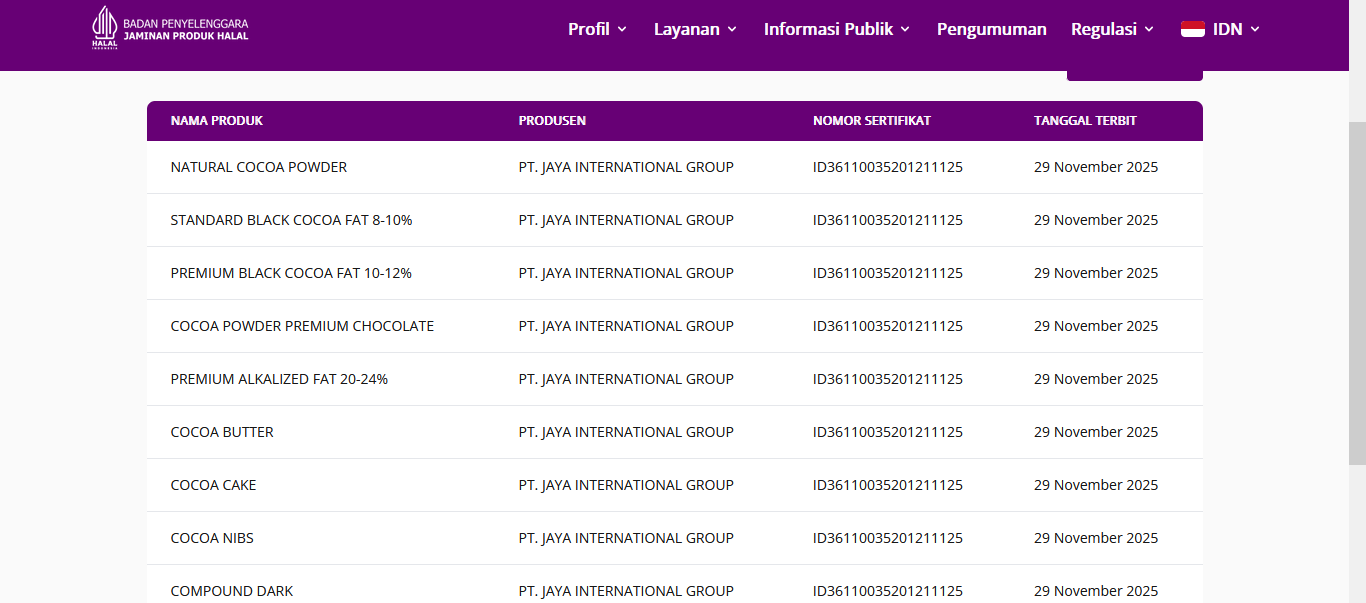
Halal cocoa powder supplier Indonesia, PT Jaya International Group, addresses the strict dietary compliance requirements of the global food and beverage (F&B) supply chain by delivering raw materials with verified traceability. Sourcing certified cocoa derivatives provides a direct solution for industries aiming to penetrate markets that mandate Islamic dietary laws. The certification process in Indonesia, governed by the Halal Product Assurance Organizing Agency (BPJPH) and the Indonesian Council of Ulama (MUI), enforces comprehensive audits covering raw material sourcing, processing machinery, and packaging logistics.
For international B2B buyers, verifying the compliance of cocoa derivatives, such as powder, butter, and liquor is a mandatory regulatory requirement for product distribution in the Middle East, Southeast Asia, and diverse consumer segments globally. Below are the details regarding the technical compliance, facility standards, and operational framework of PT Jaya International Group as an authorized provider of Halal certified cocoa commodities.
Global Demand for Halal Certified Cocoa Manufacturer
The global industrial requirement for verified food ingredients extends beyond regional preferences, functioning as a strict baseline for international trade. F&B conglomerates prioritize partnerships with a Halal certified cocoa manufacturer to ensure their final products meet the legal entry requirements of multiple international jurisdictions.
In industrial application, the Halal status of a plant based commodity like cocoa is not automatically guaranteed. The entire transformation from raw cocoa beans to refined powder involves mechanical and chemical interventions. Every input, including the water filtration system, alkalizing agents, and machinery lubricants, must be explicitly free from non compliant derivatives, specifically porcine elements and alcohol.
Market Drivers for Halal Cocoa Products
The distribution of Islamic dietary compliant cocoa products directly supports various manufacturing sectors. The dairy processing industry, industrial bakeries, and the rapidly expanding Halal cosmetic sector rely heavily on uncontaminated cocoa derivatives. In cosmetics, for example, pure cocoa butter is utilized as a base for lip balms and skin lotions. Manufacturers must provide documented proof that the extraction process of this butter involves no shared equipment with non compliant animal fats.
By sourcing materials that already possess a globally recognized Halal certificate from Indonesia, international manufacturers bypass the complex and costly process of auditing unverified raw material suppliers, streamlining their own final product certification phase.
Bulk Halal Alkalized Cocoa Powder Standards
The production of natural cocoa powder requires minimal intervention, primarily involving roasting, grinding, and fat extraction. However, the production of bulk Halal alkalized cocoa powder involves the addition of chemical agents to neutralize the natural acidity of the cocoa liquor.
During the Dutch process (alkalization), manufacturers introduce alkaline solutions, typically potassium carbonate or sodium carbonate. The Halal Assurance System (SJH) requires the manufacturer to provide a Material Safety Data Sheet (MSDS) and a separate Halal certificate for these specific chemical agents to prove they were not manufactured using bone char or other prohibited processing aids. The water used to dilute these alkaline agents must also pass purity parameters.
Facility and Cross Contamination Prevention
A core requirement for maintaining certification is the absolute prevention of cross contamination. Facilities producing compliant materials must operate dedicated production lines. If a facility processes multiple types of food products, the SJH mandates strict Sanitation Standard Operating Procedures (SSOP).
The cleaning agents, detergents, and sanitizers used on the roasting machines, hydraulic presses, and grinding mills must be documented and approved by the auditor. These cleaning agents cannot contain alcohol or enzymes derived from non compliant sources. Furthermore, the industrial lubricants used on the moving parts of the hydraulic presses must be food grade and synthetically derived, eliminating the risk of animal fat contamination during the cocoa butter extraction process.
Traceability in Halal Cocoa Processing
Traceability is the foundation of the Indonesian Halal certification framework. Auditors require a transparent paper trail connecting the exported batch of cocoa powder directly back to the specific farmer cooperatives. Traceability in Halal cocoa processing involves the implementation of batch numbering systems and stringent inventory management software.
When a shipment of raw cocoa beans arrives at the facility, it is assigned a lot number. This lot number tracks the beans through the sorting, roasting, grinding, and alkalizing phases. During an external audit, inspectors select a random batch of finished cocoa powder and require the facility management to trace it backward, presenting all records of the specific alkaline agents, machinery maintenance logs, and raw bean origins associated with that exact batch.
Your Halal Cocoa Powder Supplier Indonesia
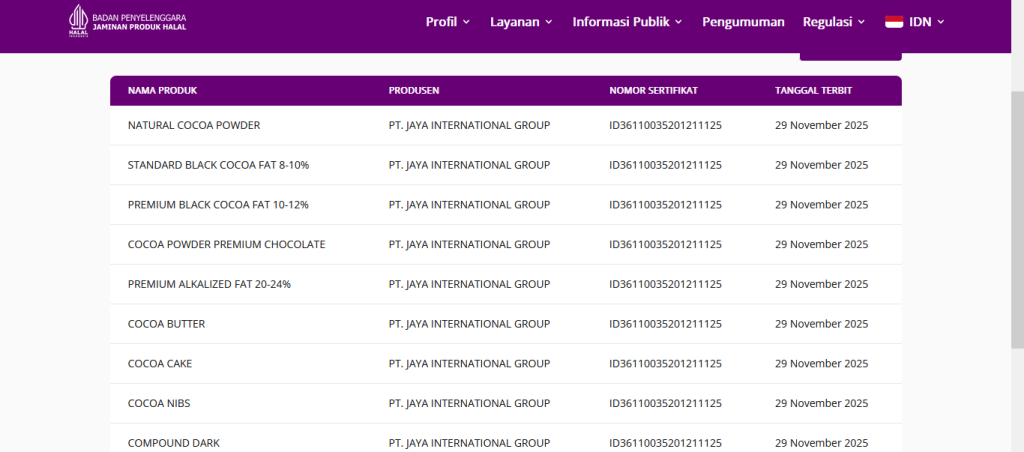
PT Jaya International Group is a registered entity in Tangerang, Banten, providing fully compliant cocoa derivatives. To meet expanding international F&B volume requirements, the company operates an independently verified production infrastructure specifically for processing Islamic dietary compliant raw materials. This ensures zero risk of cross contamination and maintains the highest standards of purity for global industrial partners.
Verified Product Portfolio
As a recognized B2B Halal cocoa butter and liquor partner, we provide:
- Compliant Cocoa Powder: Available in both natural and alkalized formats, supported by complete chemical transparency documentation.
- Pure Cocoa Butter: Extracted via mechanical pressing using verified food grade, synthetic lubricants.
- Cocoa Liquor (Mass): Processed on dedicated grinding lines, ensuring the pure cocoa paste remains uncontaminated.
Logistics from Halal Cocoa Powder Supplier Indonesia
The compliance chain does not end at the manufacturing floor; it extends through the packaging and shipping processes. A trusted supplier ensures that the logistics framework maintains the integrity of the product until it reaches the destination port.
Packaging Material Compliance
The multiply kraft paper bags and high density polyethylene (PE) liners used for packaging the 25 kilogram bulk powder must also be evaluated. The adhesives used to bind the layers of the kraft paper must be synthetically formulated or plant based, as animal based glues invalidate the Halal status of the contained product.
Container Loading Protocol
Prior to loading, shipping containers undergo a thorough inspection. Containers must be dry, odorless, and completely free from residues of previously shipped non compliant cargo (such as meat products or alcoholic beverages). PT Jaya International Group implements a standardized container sweeping and lining protocol, placing an additional moisture resistant barrier on the container floor before the pallets of cocoa powder are loaded.
Contact Us
To request our active certification documents, technical data sheets, or to arrange a sample shipment for your laboratory validation, contact PT Jaya International Group through the following official channels:
- Corporate Address: The Zora Commercial Business Living, Ruko Daikanyama Block A 07. Jl. Lingkar Botanika Utara, Lengkong Kulon, Pagedangan, Tangerang, Banten 15339, Indonesia.
- Direct Contact: +62 851 7851 7789
- Email: info@jayainternationalgroup.com
- Website: jayainternationalgroup.com
Frequently Asked Questions (FAQ) on Halal Cocoa Export
1. Is the Halal certification from Indonesia recognized globally? Yes. The certification issued by the Indonesian Halal Product Assurance Organizing Agency (BPJPH) holds mutual recognition agreements with major global Halal authorities, including JAKIM (Malaysia), MUIS (Singapore), and various certification bodies in the Middle East and Europe.
2. Are the alkaline agents used in your processing certified? All chemical inputs, including potassium carbonate used for alkalization, are procured exclusively from approved vendors who supply their own active Halal documentation and Material Safety Data Sheets (MSDS).
3. How do you ensure no cross contamination during production? Our facility operates dedicated production lines that process only plant based cocoa materials. Our newly upgraded line, released on April 13, 2026, is subjected to strict Sanitation Standard Operating Procedures (SSOP) using approved, non alcohol based cleaning agents.
4. What documentation is provided with an export shipment? Every export shipment is accompanied by a Certificate of Analysis (CoA), a Bill of Lading, a Phytosanitary Certificate, and the official Halal Certificate corresponding to the specific batch numbers loaded in the container.
5. Do the packaging materials meet compliance standards? Yes. The 25kg multiply kraft paper bags utilize synthetic, non animal derived adhesives, and the inner PE liners are manufactured from compliant polymers to ensure the product remains uncompromised during transit.
